Trying to decide between a condo and a single-family home in Belmont? You are not alone. In a town where housing costs are high and much of the housing stock is older, this choice often comes down to how you want to live day to day, what you want to spend each month, and how much responsibility you want to take on. This guide will help you compare both options in a practical Belmont-specific way so you can move forward with more clarity. Let’s dive in.
Belmont housing shapes the decision
Belmont has a housing mix that makes this choice especially relevant. A current ACS profile shows 49.13% of the town’s housing is in single-unit structures, while 43.93% is in 2-to-4-unit housing. The same profile shows that 61.67% of Belmont’s housing stock was built before 1939, which matters because older homes and buildings often come with more upkeep and more variation in condition.
Belmont is also an expensive market. Census QuickFacts lists a median value of owner-occupied housing units of $1,159,000, and 64.7% of homes are owner-occupied. That means whether you choose a condo or a single-family home, you are making a major long-term financial decision.
Compare the biggest day-to-day differences
Maintenance and repairs
One of the clearest differences is who handles upkeep. With a condo, shared building responsibilities are typically managed by the condominium association under the master deed and bylaws. These documents usually cover how maintenance, repairs, reserve funds, insurance, and common expenses are handled.
For many buyers, that setup can feel simpler. Exterior work, common walls, and shared grounds are often maintained through the association, while you handle the parts of the home that fall inside your unit. With a single-family home, you are directly responsible for the roof, siding, systems, landscaping, and future capital repairs.
Privacy and control
If privacy is a top priority, a single-family home usually has the edge. You are less likely to share walls, and you usually have more control over how your property looks and functions. That can be a meaningful benefit if you want quiet, separation, or flexibility over time.
Condos can still be a great fit, but they usually come with more shared decision-making. In Belmont, condo ownership often includes an HOA structure that governs common spaces and may limit changes to the building exterior or other shared elements. If you value convenience more than total control, that tradeoff may feel worthwhile.
Outdoor space and parking
Outdoor space is another major factor in Belmont. Single-family homes are more likely to offer private yards, driveways, and more flexibility for outdoor use. That can be especially appealing if you want room for gardening, entertaining, or simply more separation from neighbors.
Condo buyers are more likely to find shared grounds or smaller private outdoor areas, especially near village-center locations. Parking can also vary by building, so it is worth reviewing exactly what comes with each unit before you make a decision.
Understand the monthly cost picture
In Belmont, property taxes are an important part of the budget regardless of property type. The town’s FY2026 tax rate is $11.51 per $1,000 of assessed value. That alone makes it important to compare the full monthly cost, not just the mortgage payment.
FY2025 assessor data counted 4,540 single-family properties and 1,904 condominiums in Belmont. The average tax bill was $18,775.27 for single-family homes and $7,769.45 for condos. Broken down monthly, that is about $1,565 for the average single-family home and about $647 for the average condo, a difference of roughly $917 per month before HOA dues, insurance, and maintenance.
That gap helps explain why condos can look more affordable at first glance. Still, condo dues can materially change the picture. When you compare options, make sure you include:
- Principal and interest
- Property taxes
- Condo or HOA dues, if any
- Homeowners insurance
- Ongoing maintenance and repair costs
Where each option may fit in Belmont
Areas that often suit single-family buyers
Belmont includes several areas that align well with buyers looking for a house-centered lifestyle. The town describes Belmont Hill as having substantial dwellings on large, estate-like parcels. Clark Hill is characterized by spacious lots and extensive landscaping, while Belmont Park includes smaller residential lots that can still feel more private than attached housing.
Walnut Hill is also described by the town as an area of landscaped homes near the center of town. Snake Hill is a very small modern neighborhood with just seven houses. If your wish list includes more privacy, yard space, and a stronger single-family feel, these are natural areas to keep in mind.
Areas that may appeal to condo buyers
Belmont Center, Cushing Square, and Waverley are the town’s three commercial hub areas. Belmont Center serves as the civic center, Cushing Square is a south-central commercial area, and Waverley developed historically as a railroad center and streetcar suburb.
Because of that geography, condo and townhouse inventory is more likely to appear in compact, walkable, or transit-oriented settings near these hubs than in the hill neighborhoods. That is not a guarantee of current listings, but it is a useful way to think about where your search may lead.
Think beyond the purchase price
Review condo documents carefully
In Massachusetts, condo ownership is highly document-driven. The master deed, bylaws, budget, and related materials help define maintenance responsibilities, common expenses, reserve funds, and special assessments. State guidance also requires an adequate replacement reserve fund.
That means condo buyers should look beyond the asking price. A lower-priced unit may still carry higher risk if the reserve balance is low or if the association has a history of special assessments. Reviewing these documents early can help you avoid surprises later.
Know the insurance split
Insurance works differently for condos and single-family homes. In many condo buildings, the association carries a master policy that covers the building and common areas. The unit owner then needs separate coverage for the interior portions and personal property inside the unit.
For a Belmont condo purchase, that usually means budgeting for an HO-6 policy in addition to the monthly condo fee. With a single-family home, you generally carry the main homeowners policy yourself, which creates a different budgeting and coverage structure.
Consider future flexibility
A single-family home may give you more options later. Belmont approved an accessory dwelling unit bylaw in March 2025, which may allow some single-family owners to add an ADU if the lot and zoning conditions qualify. That could matter if you are thinking ahead about multigenerational living, a separate guest space, or rental income.
That kind of flexibility is not the right goal for every buyer, but it is worth considering if your needs may change over time. In a high-cost market, having more options later can be a meaningful advantage.
Watch how Belmont may evolve
Belmont’s planning direction also matters. Under MBTA Communities requirements, the town must zone for multifamily housing near commuter rail service, with at least 50% of the land area and unit count within one-half mile of commuter rail stations. The town has also said it must zone for 1,632 multifamily units.
Belmont Center’s 2026 zoning overlay project was framed by the town as a way to create new housing options for seniors, young professionals, and town employees. In practical terms, that suggests future condo and townhouse growth is more likely near transit-served and village-center locations than in large-lot hill areas. If you are choosing between lifestyle types, that future pattern is worth keeping on your radar.
A practical Belmont decision framework
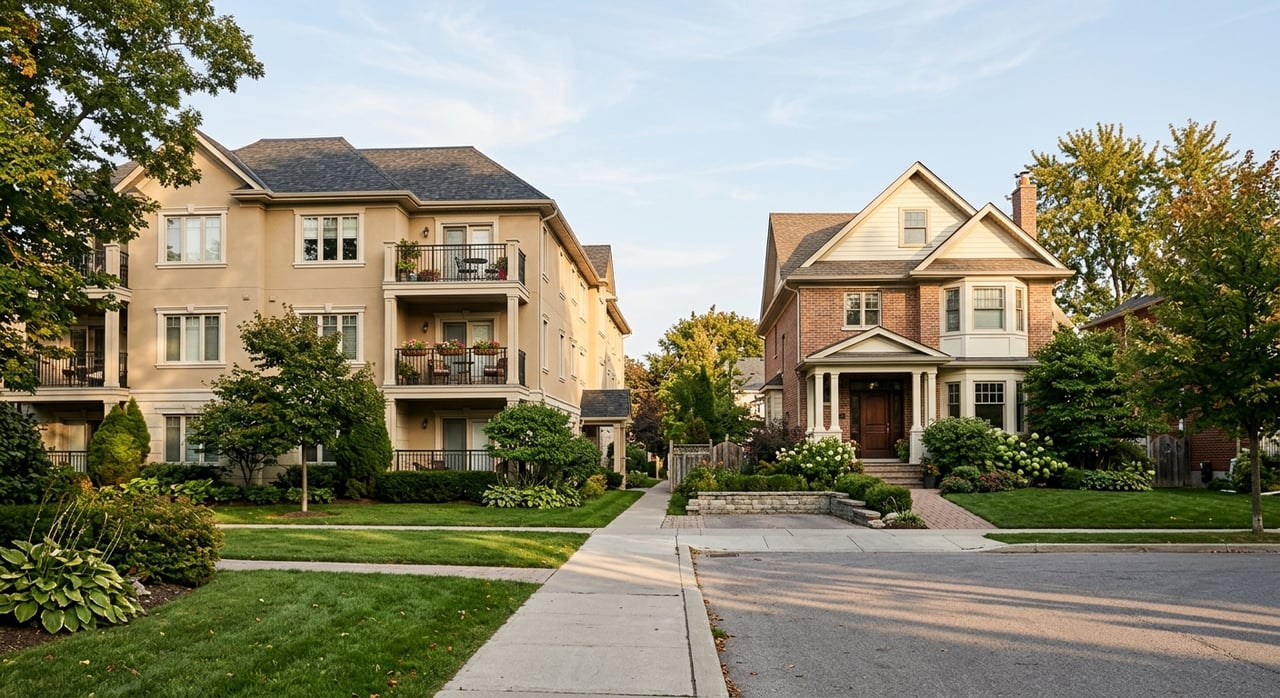
If you are still weighing the two, a simple framework can help. A condo often makes more sense if you want a lower base purchase price than a comparable single-family home, less exterior maintenance, and a more compact location near Belmont Center, Cushing Square, or Waverley.
A single-family home often makes more sense if you want more privacy, a yard, more control over improvements, and greater long-term flexibility. In Belmont, the better fit usually comes down to three things: your budget, your maintenance tolerance, and your future plans.
Here are smart questions to ask yourself before you choose:
Questions to ask about a condo
- What are the monthly dues?
- What do those dues cover?
- How strong is the reserve fund?
- Have there been recent special assessments?
- What are the parking, pet, and rental rules?
Questions to ask about a single-family home
- How old are the roof and major systems?
- How much yard and outdoor space do you want?
- Is the property in a local historic district or subject to design review?
- Could the lot support an ADU in the future?
The right answer is not always the one with the lower price tag. It is the one that fits how you want to live in Belmont now and what you want your property to do for you over time.
If you are comparing homes in Belmont and want guidance tailored to your budget, goals, and preferred lifestyle, The Marrocco Group is here to help you evaluate the tradeoffs with clarity and confidence.
FAQs
What is the main difference between buying a condo or single-family home in Belmont?
- In Belmont, the biggest differences are usually maintenance responsibility, privacy, outdoor space, and total monthly carrying cost.
How much lower are property taxes for condos compared with single-family homes in Belmont?
- Based on Belmont FY2025 assessor averages, the average monthly property tax works out to about $647 for condos and about $1,565 for single-family homes.
What should Belmont condo buyers review before making an offer?
- Belmont condo buyers should review the monthly dues, what the dues cover, the reserve fund balance, any history of special assessments, and the building rules.
Which Belmont areas may be more likely to have condo or townhouse options?
- Belmont Center, Cushing Square, and Waverley are the areas where condo or townhouse inventory is more likely to appear because they are the town’s compact commercial and transit-oriented hubs.
Why might a single-family home offer more flexibility in Belmont?
- A single-family home may offer more flexibility because you typically have more control over the property and, in some cases, may have the option to pursue an ADU if zoning and lot conditions allow.
How should Belmont buyers compare the true monthly cost of each option?
- Belmont buyers should compare mortgage costs, property taxes, insurance, maintenance, and any condo or HOA dues rather than focusing only on principal and interest.